
- Treatments
- Total & Partial Knee Replacement
- Hip Replacement
- Shoulder Replacement
- Robotic-Assisted Joint Replacement
- Revision Joint Replacement Surgeries
- Spine Surgeries
- Complex Trauma & Fracture Management
- Arthroscopic & Minimally Invasive Procedures
- Peri-Prosthetic Infection Management
- Pre & Postoperative Rehabilitation Guidance
- Orthopaedic Consultation & Diagnostics
Hip Replacement
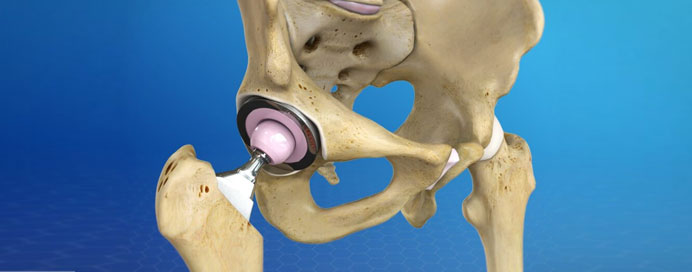
Hip replacement is a surgical procedure in which a damaged or diseased hip joint is replaced with an artificial joint (prosthesis) to relieve pain and restore function. It is commonly performed in patients with severe arthritis, fractures, or hip joint degeneration.
Indications for Hip Replacement
Hip replacement is usually recommended when conservative treatments fail. Common indications include:
- Osteoarthritis – Degeneration of the hip joint causing pain and stiffness.
- Rheumatoid Arthritis – Chronic inflammatory joint disease affecting the hip.
- Hip Fractures – Especially in elderly patients with femoral neck fractures.
- Avascular Necrosis – Death of hip bone tissue due to poor blood supply.
- Congenital Hip Disorders – Such as developmental dysplasia of the hip.
- Severe Hip Pain – Interfering with daily activities, walking, or sleep.
- Loss of Mobility – Difficulty in walking, climbing stairs, or standing.
Types of Hip Replacement
- Total Hip Replacement (THR) – Both the acetabulum (hip socket) and femoral head (ball) are replaced.
- Partial Hip Replacement (Hemiarthroplasty) – Only the femoral head is replaced, usually after fractures.
- Hip Resurfacing – Bone-preserving procedure, mainly in younger patients; the femoral head is capped rather than replaced.
Materials Used in Prosthesis
- Metal-on-Polyethylene – Most common, durable, low wear.
- LarCeramic-on-Ceramic – Very smooth, long-lasting, less wear, less risk of osteolysis.ge
- Metal-on-Metal – Rarely used due to risk of metal ion release.
- Ceramic-on-Polyethylene – Combines smooth surface with durability.
Surgical Procedure
- Anesthesia: General or spinal anesthesia.
- Incision: Made at the side or back of the hip to access the joint.
- Removal of Damaged Joint: Diseased femoral head and damaged cartilage of the socket are removed.
- Preparation of Bone: Femur and acetabulum are shaped to fit the prosthetic components.
- Insertion of Prosthesis: Artificial socket and femoral stem are placed; sometimes cemented, sometimes press-fit (cementless).
- Closure: Muscles and skin are sutured, and the hip is stabilized.